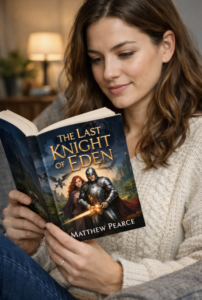
Dark fantasy works best when it gives you more than monsters and magic. It has to carry emotional weight, layered tension, spiritual stakes, and characters who feel like they could break at any second and still keep going. The Last Knight of Eden by Matthew Pearce lands in that exact space, which is why it is such a strong dark fantasy choice for women who want fiction that feels intense, meaningful, and immersive. Pearce’s official book page describes it as a dark modern fantasy built around ancient scripture, secret orders, and mythic warfare beneath the modern world, centered on Ezra Thorne after he awakens something ancient in the tunnels beneath London.
What makes this book stand out is not only the premise, but the kind of reading experience it promises. This is not soft, decorative fantasy. It is a story built on pressure: a broken home, fear of one’s own mind, dangerous power, a hidden order, and a world where faith is not simply comforting but volatile. The official description also introduces Miriam, a blade-wielding knight who sees Ezra as a possible threat, and that detail alone signals a dynamic many women readers enjoy—tension between power, duty, trust, and survival rather than flat good-versus-evil storytelling.
A dark fantasy tone that feels emotional, not empty
A lot of dark fantasy looks dark on the surface but has very little emotional depth underneath. The Last Knight of Eden sounds different because its darkness is tied to internal conflict. Ezra is not introduced as a polished chosen one. He is suspended from school, carrying family pain, and frightened by what his own mind might do. That kind of setup matters. It creates a more human entry point into a supernatural story, which is often what makes fantasy click with women readers who want character-driven fiction, not just worldbuilding for its own sake.
There is also something powerful about the way the book frames ability and burden. Ezra’s voice carries danger. Scripture in this world is spoken, not written. Relics awaken, scrolls respond, and visions begin to haunt him. That creates a dark fantasy atmosphere where language itself has weight, and where power is deeply tied to identity and responsibility. It feels intimate, not distant. Women readers who enjoy stories where symbolism and emotion matter just as much as plot twists will likely find that especially satisfying.
And the London-underworld setting adds another layer of appeal. The official description places ancient forces under a modern city, which gives the book that hidden-history energy many fantasy readers love. It feels like the kind of story where everyday life and myth are pressed together until sparks fly. That contrast can be incredibly compelling because it lets the fantasy feel close to home while still delivering the thrill of secret worlds and dangerous lore.
A female knight in the center of the tension raises the stakes in the best way ⚔️
One of the most exciting parts of the description is Miriam. She is introduced as a blade-wielding knight, and she is not there just to support the hero. She is positioned as someone who doubts him, watches him, and understands what uncontrolled power can do. That is a strong signal that this story may offer the kind of female presence many women readers want in dark fantasy: competent, morally grounded, and fully part of the central conflict.
That matters because women readers often connect deeply with stories where female characters are allowed to be decisive, guarded, sharp, and spiritually or morally complex. Miriam’s role suggests exactly that. She is not framed as ornamental. She is part of the book’s pressure system. Her skepticism toward Ezra adds friction, and friction is where great dark fantasy usually comes alive.
It also hints at a richer emotional landscape. When a story puts a powerful female character in direct tension with the protagonist, it opens the door to layered relationships—respect, suspicion, loyalty, rivalry, even unexpected tenderness—without sacrificing momentum. Women readers who love stories with emotional complexity and earned trust arcs will recognize the promise in that setup immediately.
Faith, danger, and mythic warfare make this feel bigger than standard fantasy
Pearce’s own site describes The Last Knight of Eden as a dark, modern fantasy blending ancient scripture, secret orders, and mythic warfare, and that blend is a major reason it can resonate strongly with women readers who like fantasy with thematic weight.
This is not just a battle story. It appears to be a story about voice, calling, fear, and the consequences of what happens when power and belief collide. For many women, especially readers who enjoy fiction with spiritual tension or symbolic depth, that combination can be incredibly engaging. It gives the book a sense of gravity. The fantasy elements are not only there to entertain; they seem designed to explore identity, purpose, and the danger of being chosen for something you do not fully understand.
Pearce’s author site also consistently presents him as a writer working across faith, fantasy, and emotionally charged storytelling, which helps explain why this novel’s premise feels so layered. His website describes him as writing across genres while maintaining themes that challenge, uplift, and provoke thought, and his background includes advanced study in English and an MFA. That background shows up in the way the book description is written: the language is cinematic, but it also carries symbolism and mood.
For women readers who are tired of fantasy that feels all action and no soul, that is a real advantage. The Last Knight of Eden sounds like a story that wants to stay with you.
It fits beautifully into the tradition of women-loving speculative fiction communities 📚
Women have long been an essential part of fantasy and speculative fiction readership, authorship, and fandom, and there is a reason dark fantasy with emotional and thematic depth continues to connect. Wikipedia’s overview of women in speculative fiction reflects the long and influential role women have played across the genre, and modern conversations around women readers and creators in fantasy continue to grow.
That context matters when recommending a title like The Last Knight of Eden to women. The book’s core ingredients—hidden histories, reluctant power, dangerous spirituality, and a capable female knight—line up with the kind of storytelling many women readers champion in fantasy spaces. It invites discussion, not just consumption. It gives readers something to feel and something to analyze.
It also supports book-club style conversation, which many women readers love. There is a lot here to unpack: Ezra’s fear of his own mind, the symbolism of spoken scripture, the role of Miriam, the ethics of power, and the larger question the description poses—whether Ezra was chosen to save what remains or burn it down. That is rich material for readers who enjoy talking about character psychology, moral tension, and meaning after they finish a chapter.
Why this recommendation feels especially timely for women readers now
There is also a broader cultural reason this kind of dark fantasy can hit hard right now. Across major women-focused news and rights reporting, many conversations are centered on resilience, voice, identity, and the fight to hold ground in difficult times. UN Women continues to publish global reporting and updates focused on women and girls, and outlets like Women’s eNews and AP’s women’s rights coverage track how these issues are unfolding in public life. Reuters, WHO, and OHCHR are also publishing ongoing reporting and updates related to women’s rights, health, and protection.
That does not mean readers only want issue-driven fiction. It means stories about power, danger, survival, and voice often land differently when they echo what people are already emotionally processing in the real world. A dark fantasy like The Last Knight of Eden offers escape, yes, but it also offers a symbolic experience of courage under pressure. That is one reason women readers so often gravitate toward fantasy that is emotionally sharp and spiritually charged rather than shallow spectacle.
And because this book appears to center both a vulnerable male protagonist and a formidable female knight, it creates a strong balance. Women readers are not asked to sit through a one-note power fantasy. They are invited into a world where strength is complicated, trust is earned, and danger has meaning.
Conclusion
The Last Knight of Eden looks like the kind of dark fantasy fiction that women readers can really sink into: moody, intelligent, emotionally charged, and full of tension between destiny and destruction. The official description promises hidden orders, ancient forces, spoken power, and a blade-wielding Miriam who adds exactly the kind of sharp female energy many women want in fantasy fiction.
For women who love dark fantasy that blends myth, modern settings, spiritual symbolism, and high-stakes character conflict, this is a standout recommendation. It sounds immersive. It sounds layered. It sounds dangerous in the best way. 🖤✨
For readers who also enjoy staying connected to women-centered reporting and conversations, these are strong authority sources to keep bookmarked alongside your reading list: Wikipedia: Women in Speculative Fiction, UN Women News, Women’s eNews, AP News Women’s Rights, Reuters on women’s rights, and WHO women and health news update.